
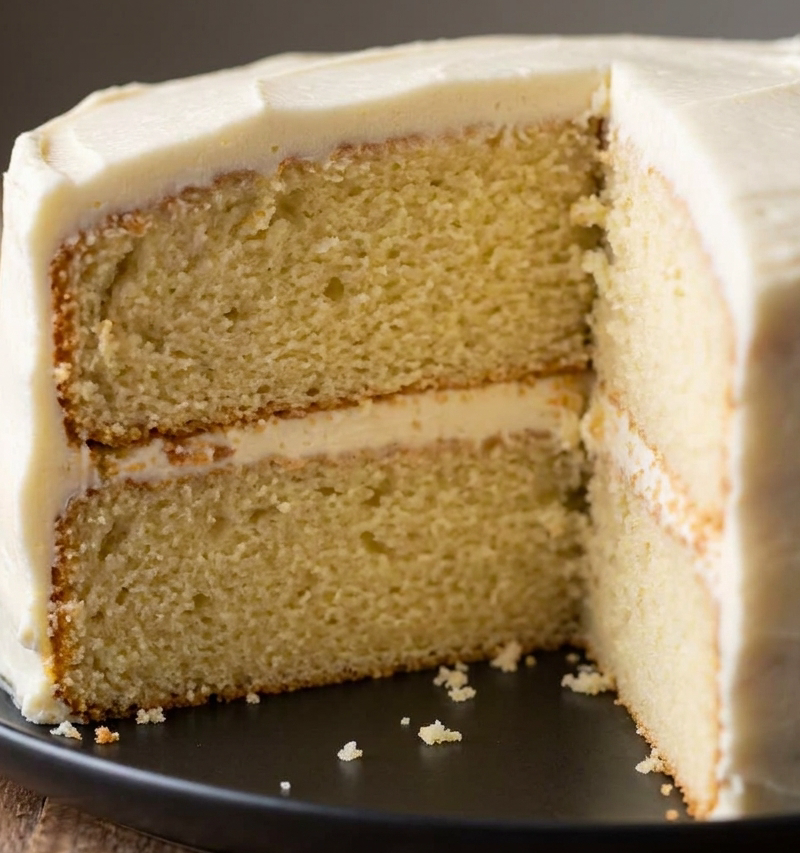
Vanilla Sponge Cake
A classic two-layer vanilla sponge with a fine, soft yellow crumb, a modest buttercream filling and a thin, smooth coat of pale vanilla buttercream. Makes 12 slices. Batch yield: One two-layer 20 cm cake, cut into 12 slices. One serving: 1 slice, or one-twelfth of the cake; approximately 120 g, best confirmed by weighing the finished cake and dividing by 12. Prep means total non-oven elapsed time: 60 minutes for butter softening and ingredients losing their chill, 20 minutes to finish mixing and dividing the batter, 120 minutes for complete cooling, and 20 minutes to fill and frost. Measuring, lining tins and oven preheating overlap the softening period; making the buttercream overlaps cooling, so neither is counted twice. Both tins bake together in one 35-minute oven batch. Total elapsed time is approximately 255 minutes, including about 70 minutes of hands-on work. Allow extra cooling time in a warm kitchen. Appliances: Oven; Electric hand mixer; Refrigerator for refrigerated storage; Freezer for optional frozen storage. Equipment: Two 20 cm round cake tins, at least 5 cm deep; Baking paper; Digital kitchen scales; Measuring jug; Measuring spoons; Mixing bowls; Whisk; Sieve; Flexible spatula; Wire cooling rack; Cake-testing skewer; Palette knife or offset spatula; Cake board or serving plate; Sharp knife; Airtight cake container. Allergens: Contains wheat flour, dairy butter and milk, and eggs. Check packaged ingredient labels for additional allergens and cross-contact warnings. Nutrition is estimated per one-twelfth of the complete frosted cake; the rounded macros provide approximately 520 kcal. Storage: Keep covered in an airtight cake container at a cool room temperature of 18–20°C for up to 2 days. In a warmer room, refrigerate instead. Refrigerated cake keeps for up to 5 days total; allow a slice to stand at room temperature for 30–45 minutes before eating for a softer crumb and buttercream. Freeze individual slices in airtight freezer-safe containers for up to 2 months. Thaw covered overnight in the refrigerator, then bring to room temperature before eating.
220 min
Prep
35 min
Cook
12
Serves
520
Calories
Macros · per serving
5g protein
63g carbs
28g fat
Ingredients
For 12 servings
- 175 g Unsalted butter, for the sponge
- 250 g Caster sugar
- 4 eggs Large eggs, approximately 200–240 g without shells
- 250 g Plain flour
- 10 g Baking powder
- 3 g Fine salt, for the sponge
- 150 ml Whole milk, for the sponge
- 10 ml Vanilla extract, for the sponge
- 200 g Unsalted butter, for the buttercream
- 300 g Icing sugar
- 20 ml Whole milk, for the buttercream
- 5 ml Vanilla extract, for the buttercream
- 1 g Fine salt, for the buttercream
Instructions
- 1
Allow about 60 minutes for both portions of butter to soften at room temperature, keeping them separate. The butter should indent easily when pressed but should not be oily or melted. Let the whole eggs lose their fridge chill during this time. Measure the sponge milk during the final 20 minutes so it is not fridge-cold when mixed.
- 2
During the softening time, line the bases and sides of two 20 cm round cake tins, at least 5 cm deep, with baking paper; no greasing is needed. Preheat the oven to 180°C conventional / 350°F conventional / 160°C fan. Position a shelf centrally so both tins can sit side by side with a little space between them.
- 3
Whisk the flour, baking powder and 3 g salt together in a bowl. In a separate large bowl, beat the 175 g softened butter and caster sugar with an electric hand mixer for 4–5 minutes, until noticeably paler and fluffy. Scrape the bowl and beaters halfway through.
- 4
Beat the eggs into the butter mixture one at a time, mixing for about 40 seconds after each and scraping the bowl as needed. Beat in the 10 ml vanilla extract. The mixture may look slightly split; the flour will help it come together.
- 5
On the lowest mixer speed, add one-third of the flour mixture, followed by half the 150 ml milk. Repeat, then add the remaining flour mixture. Mix only until incorporated. Finish with a spatula, scraping the bottom of the bowl, to make a soft, thick batter without dry pockets. Do not taste raw batter because it contains uncooked flour and eggs.
- 6
Weigh the finished batter and divide it equally between the prepared tins, rather than relying on a fixed weight. Expect roughly 1,050–1,090 g batter in total, depending on the eggs. Level both surfaces gently.
- 7
Bake both tins together for 30–35 minutes, allowing 35 minutes in the schedule. Avoid opening the oven during the first 25 minutes. The cakes are ready when lightly golden, their centres spring back gently and a skewer inserted in the middle comes out without wet batter. If necessary, continue baking until these cues are met.
- 8
Cool the cakes in their tins on a wire rack for 10 minutes. Carefully turn them out, remove all baking paper and place upright on the rack. Allow about 110 minutes more, until completely cool through the centre. Do not frost warm cakes, as the buttercream will melt.
- 9
While the cakes cool, make the buttercream. Sift the icing sugar. Using clean beaters and a clean bowl, beat the 200 g softened butter with the electric hand mixer for 4 minutes until pale and creamy. Add the icing sugar in three additions, starting on low speed each time. Add the 20 ml milk, 5 ml vanilla extract and 1 g salt, then beat for 2–3 minutes until smooth and spreadable. Stir slowly with a spatula to remove large air bubbles. Keep covered at cool room temperature until the cakes are cold.
- 10
Place one cold cake layer on a cake board or serving plate. Spread approximately 150 g buttercream evenly over it, then place the second layer on top. Use the remaining buttercream for a thin outer coat: spread a light smear over the top and sides to catch crumbs, then immediately smooth on the rest. Allow about 20 minutes for filling and coating; no chilling is required. Weigh the finished cake if you want an accurate serving weight, then divide into 12 equal slices.
Cook it this week.
NeatEat plans Vanilla Sponge Cake — and the rest of your week — around your budget, groceries included.