
Budget meal planning
How to meal plan on a budget
The method in seven steps, plus a complete 7-day plan for two people — breakfast, lunch and dinner — costed line by line at $85.27.
By Joao Dunlap · · 10 min read

The short version
- Pick your number first. Then fill the week up to it — never the other way round.
- Build on 6–8 cheap ingredients that repeat, so nothing rots in the drawer.
- Cook 7 dinners, eat 14 meals. Leftovers are planned, not accidental.
- A full week for two — all three meals — comes to $85.27 below.
- Or skip the arithmetic: NeatEat builds the week and the costed list for your store.
Most meal planning starts with the food: pick seven recipes, write the list, go shopping. Then the receipt lands $60 over, and by Thursday half the produce is soft.
Budget meal planning flips the order. You set the number first, then treat the week as a container you fill up to that line and no further. Here is the method, then a full week costed to the cent.
$85.27
Full week, two people, all three meals
$6.09
Per person, per day
7 → 14
Dinners cooked → meals eaten
Why budget meal plans fall apart
Three failure modes account for nearly all of it, and none are about willpower.
How to meal plan on a budget, in 7 steps
- 1
Set the number before you look at any food
Divide last month's grocery spend by 4.3. Use your card statements, not a guess — most people underestimate by 20–30%.
- 2
Count the meals you actually need
Two people × seven days × three meals is 42, but you will not cook 42 times. Subtract work lunches, the Friday takeout, dinner at a friend's. Planning for meals that never happen is the fastest way to waste food.
- 3
Pick base ingredients first, recipes second
One or two cheap proteins, one or two starches, four or five vegetables that keep. Recipes get chosen because they use that palette. This single reversal kills ingredient sprawl.
- 4
Plan the leftovers on purpose
Monday's chicken is Friday's fried rice. Thursday's lentil pot is Friday's lunch. Deliberate leftovers roughly halve both your cooking time and your cost per meal.
- 5
Price the list before you leave the house
Put a price next to every line. Nearly everyone skips this, and it is the step that does the work — a list at $112 against a $85 target tells you to fix it now, not at the checkout with a full cart. This is the step NeatEat exists to remove: it prices the list against your store as the week is built, so the total is never a surprise.
- 6
Cut from the protein line
Protein is usually 35–45% of a grocery bill. Swapping two meat dinners for beans takes $10–14 off a week for two. Shaving pennies off produce will not close a $20 gap.
- 7
Compare the receipt to the plan
Buy what is written down, then note where the receipt diverged. That gap is the useful data. After three or four weeks the planned number and the real number converge — faster if the app is keeping the running total for you.
The same seven steps, by hand and in the app
On your own
With NeatEat
Work out a weekly figure from your statements.
Type your number once. It stays the ceiling every week.
Hunt for recipes that share ingredients.
The week is built from a library that already repeats its base ingredients.
Write the list, then price every line by hand.
The grocery list builds itself, priced against your store.
Over budget? Swap meals and re-add the total.
Swap a meal and the list and the total update with it.
Check every recipe against your allergies yourself.
Allergies and diets are hard filters — flagged food never appears.
About 45 minutes, every week.
About two minutes, once.
A real 7-day plan for two people
The method applied: 42 meals, ten base ingredients, seven cooking sessions. Every lunch but two is the night before. Prices are a mid-range US supermarket in August 2026, and the list assumes you have oil, salt, pepper and dried spices.
The week · 2 people · $85.27
Monday
- Break
- Oats with banana
- Lunch
- Tuna sandwiches
- Dinner
- Sheet-pan chicken thighs, potatoes, broccoli
Tuesday
- Break
- Eggs on toast
- Lunch
- Sheet-pan chickenLeftovers
- Dinner
- Black bean and rice bowls with peppers
Wednesday
- Break
- Oats with banana
- Lunch
- Bean and rice bowlsLeftovers
- Dinner
- Beef and cabbage skillet over rice
Thursday
- Break
- Eggs on toast
- Lunch
- Beef and cabbageLeftovers
- Dinner
- Lentil soup with carrots and tomatoes, bread
Friday
- Break
- Oats with banana
- Lunch
- Lentil soupLeftovers
- Dinner
- Chicken fried rice, using Monday's chicken
Saturday
- Break
- Eggs on toast
- Lunch
- Fried riceLeftovers
- Dinner
- Pasta with tomato and spinach
Sunday
- Break
- Oats with banana
- Lunch
- Chickpea salad with bread
- Dinner
- Black bean tacos with cabbage slaw
Nothing is bought for a single meal. The cabbage is in Wednesday's skillet and Sunday's slaw, the rice carries three dinners, and Monday's chicken pack does double duty on Friday.
Cook these from the library
Six from the NeatEat library that fit a week like this one — cheap ingredients, few pans, nothing over 50 minutes. Tap any for the full method, or get the app and it will slot them into your week for you, priced.
 20 min
Cheap and Cheerful Egg Fried Rice
The leftover-rice dinner. Eggs do the protein work.
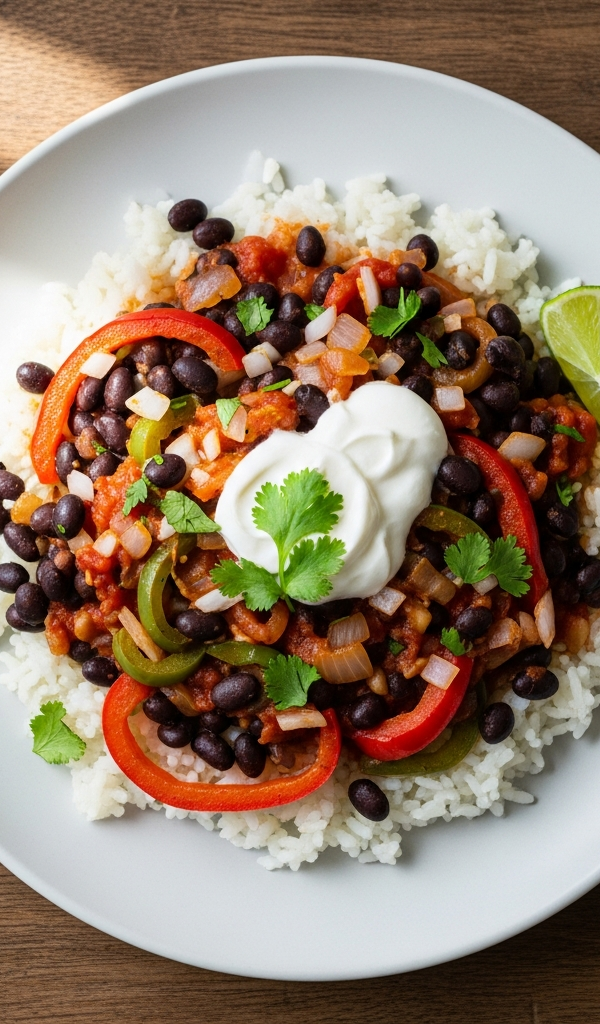 45 min
Simple Black Bean and Rice Skillet
One pan, under 40 cents of protein a serving.
 20 min
Hearty Potato and Lentil Stew
Makes dinner and the next day's lunch in one pot.
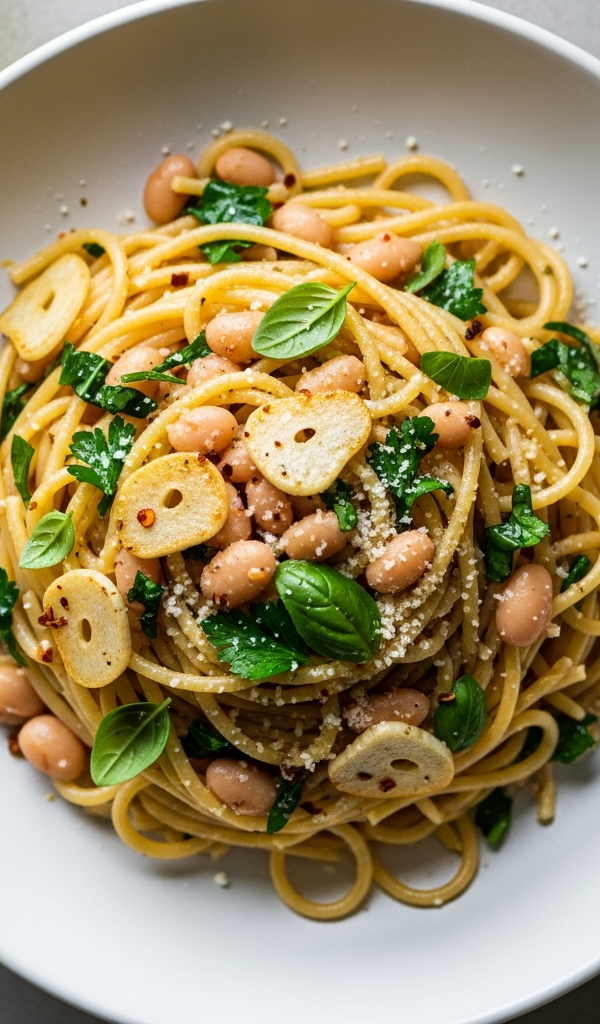 20 min
Budget Garlic and Herb Pasta with White Beans
Pantry-only. The night you forgot to shop.
 20 min
Cabbage and Lentil Stir-Fry with Rice
Cabbage keeps all week, so this is a Friday dish.
 50 min
Sheet-Pan Chicken with Roasted Chickpeas
One tray, and the leftovers carry two more meals.
The shopping list, priced
The same week as a list, grouped so you walk the store once.
| Item | Quantity | Price |
|---|---|---|
| Yellow onions | 3 lb bag | $3.49 |
| Garlic | 1 head | $0.79 |
| Carrots | 2 lb bag | $2.29 |
| Russet potatoes | 5 lb bag | $4.49 |
| Broccoli crowns | 2 | $3.48 |
| Green cabbage | 1 head | $2.49 |
| Bell peppers | 2 | $2.58 |
| Roma tomatoes | 4 | $2.36 |
| Bananas | 6 | $1.86 |
| Baby spinach | 10 oz | $2.99 |
| Item | Quantity | Price |
|---|---|---|
| Bone-in chicken thighs | 5 lb pack | $8.95 |
| Ground beef, 80/20 | 1 lb | $5.49 |
| Eggs | 18 count | $4.98 |
| Dried black beans | 1 lb | $1.99 |
| Dried lentils | 1 lb | $1.89 |
| Canned chickpeas | 2 cans | $2.18 |
| Canned tuna | 2 cans | $2.58 |
| Item | Quantity | Price |
|---|---|---|
| Long-grain white rice | 5 lb bag | $5.49 |
| Rolled oats | 42 oz | $4.29 |
| Pasta | 2 lb | $2.58 |
| Corn tortillas | 30 count | $2.49 |
| Sandwich bread | 1 loaf | $2.49 |
| Canned diced tomatoes | 2 cans | $2.38 |
| Milk | 1 gallon | $3.89 |
| Plain yogurt | 32 oz | $3.99 |
| Cheddar | 8 oz block | $2.79 |
| Week total · 2 people · 7 days | $6.09 per person per day | $85.27 |
Hitting a smaller number
$85 is just where this basket landed. The useful thing is knowing which levers move it.
- Drop the ground beef, make Wednesday a second bean night — $5.49.
- Frozen broccoli and spinach instead of fresh — about $2.26, and no spoilage clock.
- Breakfast becomes oats only, no eggs or bread — $7.47.
- Store brands across dairy and pantry — about $4.56.
Stack all four and the same seven dinners land at $65.49 — $19.78 off without changing a single meal.
The floor is about $55
Going lower means giving up meat, not trimming around it. Swap both meat lines for dried pulses and peanut butter, cut the yogurt, cheddar, tuna, bread, peppers and fresh tomatoes, and move to frozen veg. That basket is $55.12 — $3.94 per person per day, still three meals a day. It is nutritionally sound and genuinely repetitive, which is why it works better as a reset month than a permanent setup.
If you have more room
Spend it on protein variety first — it is what stops a repeating week feeling repetitive. A pork shoulder and a bag of frozen shrimp runs about $14 and changes three dinners. Extra fruit next. Snacks last: that line grows to fill whatever space you leave it.
The ingredients that do the most work
Mistakes that quietly blow the budget
- 1Shopping without a total. A list keeps you on task; a priced list keeps you on budget.
- 2Bulk on reflex. Bulk is only cheaper if you eat all of it.
- 3Seven ambitious dinners. Two involved and five simple survives a real week.
- 4Ignoring the cupboard. Most households start the week with $10–20 they forgot about.
- 5Snacks outside the plan. Routinely 15–20% of the bill.
- 6Judging it on week one. The number gets accurate around week three.
Doing this automatically
Everything above is one loop done by hand: choose a number, pick meals that fit, price the list, adjust. It works, and it costs about 45 minutes a week. NeatEat is that loop as an app — tell it your store, who you are feeding and your number, and it builds the week plus the grocery list with the total live the whole time. Allergies and diets are hard filters, so flagged food never appears at all. Free on iOS and Android, and the recipe library is browsable here first.
Frequently asked questions
How much should two people spend on groceries per week?
A workable range for two adults cooking most meals at home is $75-110 a week in the US in 2026. The plan on this page comes to $85.27 for a full week of breakfasts, lunches and dinners, which is $6.09 per person per day. Below about $60 a week you are relying on beans, lentils and eggs for most of your protein, which is perfectly healthy but limits variety.
Can you really do a meal plan on $50 a week for two people?
Close to it, but not quite, and only without meat. The lean version of this plan - both meat lines swapped for dried pulses and peanut butter, no yogurt, cheese, tuna or bread, and frozen vegetables instead of fresh - comes to $55.12 for a full week of three meals a day, which is $3.94 per person per day. Getting under $50 from there means dropping a meal a day or cooking a much smaller variety, so $55 is a fair floor.
What is the first step in meal planning on a budget?
Set the weekly number before you look at any recipes. Divide your monthly grocery spend by 4.3 to get a realistic weekly figure, using your card statements rather than an estimate. Every later decision - which protein, how many meals, which vegetables - follows from that number, so choosing recipes first is what causes plans to come in over.
How do I stop wasting food when I meal plan?
Apply the repeat test: every ingredient on the list has to appear in at least two meals. Waste is almost always caused by single-use ingredients bought for one recipe, so a week built on six to eight repeating base ingredients wastes very little. Buying vegetables that keep - cabbage, carrots, onions, potatoes - for the back half of the week helps too.
Is it cheaper to meal plan or to buy groceries as you go?
Meal planning is reliably cheaper, mostly because it removes unplanned purchases. Shopping several times a week means several chances to add items that were not needed, and those additions are usually the highest-margin products in the store. A single planned shop against a priced list also lets you catch an over-budget week before you have paid for it.
Is there an app that plans meals around a budget?
Yes - that is what NeatEat does. You set a weekly budget and pick your store, and it builds a full week of meals plus the grocery list to match, keeping the running total under your number. Swapping a meal updates both the list and the total. Most meal planning apps organise recipes and leave the cost to you; the budget is the constraint NeatEat plans against.
How long does meal planning take with an app?
Doing it by hand takes most people about 45 minutes a week once they are practised - setting the number, choosing meals that share ingredients, writing the list and pricing it. In NeatEat the same output takes about two minutes, because the pricing and the grocery list are generated with the week rather than after it.
Does NeatEat cost anything?
No. NeatEat is free on iOS and Android. You set a weekly budget, pick your store, and it generates the week's meals and a matching grocery list that comes in under your number.